There is a particular kind of violence in being invisible to the world and your region. It is not the violence of bullets, bombs or drones, but the slower, quieter violence of indifference: the sense that one’s suffering simply does not register on the scales by which the world measures tragedy.
For millions of Africans living through some of the deadliest conflicts of the twenty-first century, this is not an abstraction. It is daily life.
Since February 2026, global attention has been consumed by the U.S.-Israeli war against Iran, layering itself atop already-saturated coverage of Ukraine and Gaza.
What makes the Middle East case particularly stark is its global economic dimension, especially the blockade of the Strait of Hormuz. These are real wars with real and devastating consequences, and they deserve the world’s concern.
But their dominance of the global conscience has come at a cost: the near-total eclipse of conflicts in Sudan, Ethiopia and the Democratic Republic of Congo (DRC)—wars that, by almost any measure of human suffering, rank among the gravest crises on the planet.
The wars in Ukraine and Gaza have undoubtedly had horrendous humanitarian and geopolitical consequences. Yet, when both the human toll and the level of attention are considered, the data suggests that conflicts in Africa receive comparatively less international coverage. Consequently, international responses to these African crises have been woefully inadequate.
Crises of staggering scale, met with deafening silence
Consider Sudan. The human cost has been brutal by any standard, with more than 150,000 people reportedly killed.
According to the United Nations’ 2026 Humanitarian Needs and Response Plan, 33.7 million people in Sudan now require humanitarian assistance—the highest figure recorded for any country in the world.
The United Nations High Commissioner for Refugees estimates that more than 11 million people, approximately one in every five Sudanese, have been forcibly displaced.
Sudan has consequently become the world’s largest displacement crisis, with approximately 13.6 million people uprooted in total.
By the numbers alone, United Nations agencies have described Sudan as the world’s largest humanitarian crisis, surpassing Gaza, Yemen and other major emergencies in terms of sheer scale.
Consider another African country: Ethiopia.
Data from the Uppsala Conflict Data Program indicates that 165,025 people died in the war in Tigray during 2021. In the same year, the estimated number of deaths associated with the war in Ukraine was 92,629.
The numbers behind the neglect
Ethiopia, together with Sudan and the Democratic Republic of Congo, ranks among the world’s five most urgent humanitarian crises. These conflicts are characterised by staggering levels of fatalities, atrocities, displacement and economic devastation.
Yet global media attention devoted to these conflicts has been dramatically lower than that afforded to Ukraine and Gaza.
The disparities are not subtle.
The war in Ethiopia’s Tigray region alone produced roughly 10 times the deaths recorded in Gaza, nine times those in Sudan and twice those in Ukraine.
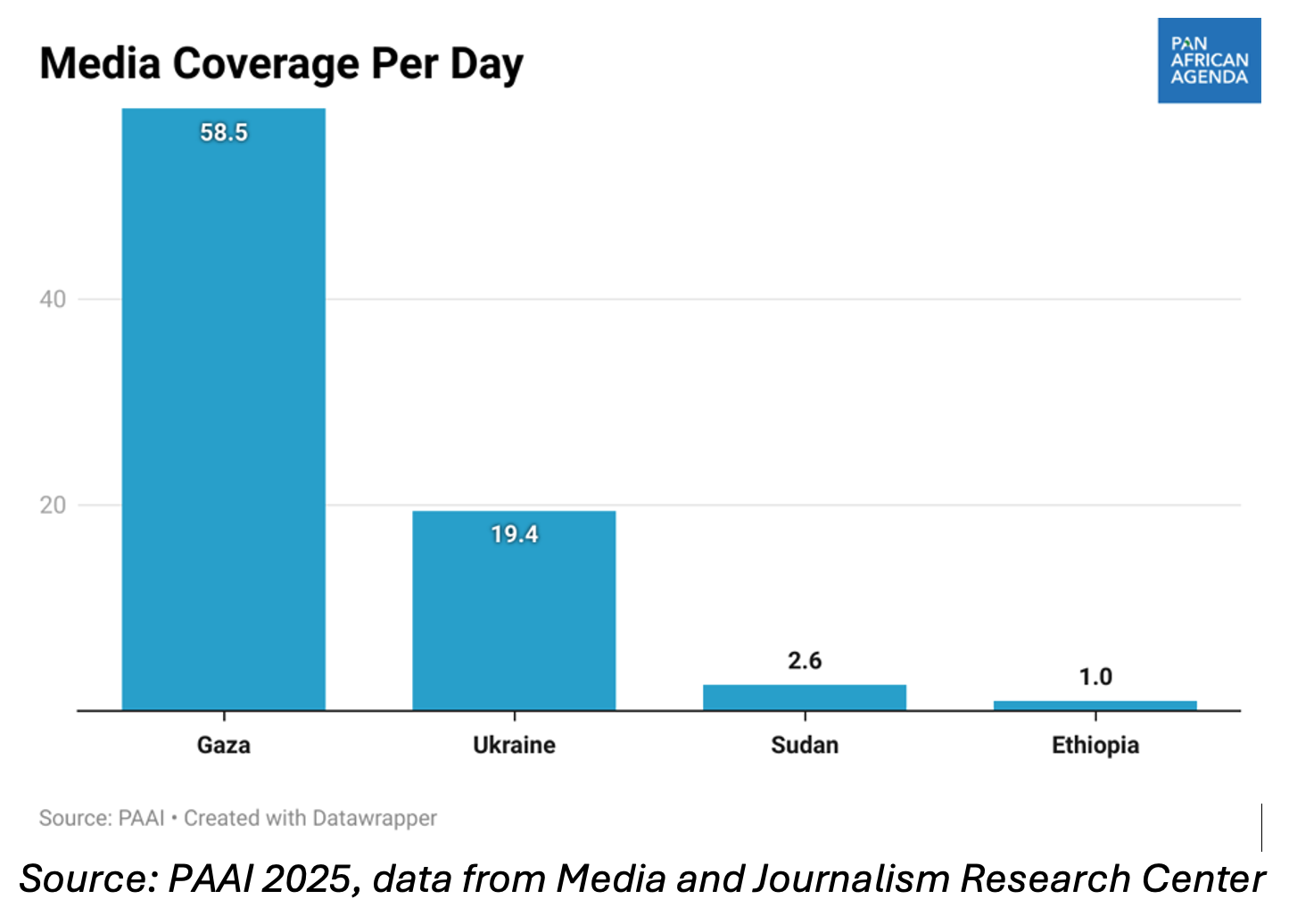
Despite this significantly higher death toll, Tigray received only 0.96% of the measured global media attention. Gaza commanded 58.5%, Ukraine received 19.43% and Sudan trailed at 2.57%.
In practical terms, this means Tigray received approximately 61 times less coverage than Gaza, 20 times less than Ukraine and nearly three times less than Sudan, despite suffering a higher death toll than all three.
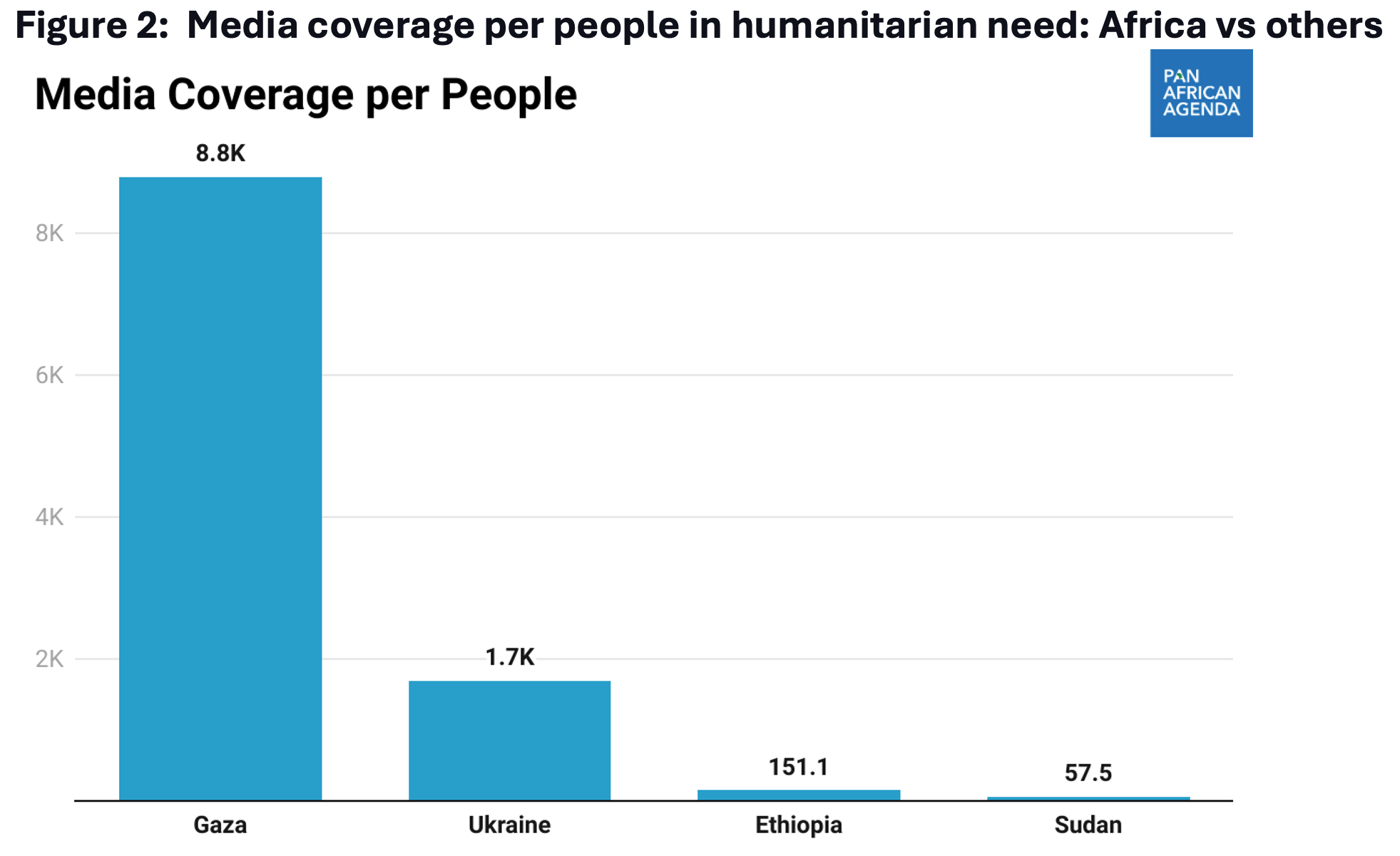
Source: PAAI 2025, data from Media and Journalism Research Center
This imbalance extends beyond any single conflict.
According to research from the Media and Journalism Research Center, Gaza and Ukraine have averaged approximately 58.5 and 19.4 articles per day respectively.
Meanwhile, some of the world’s most devastating crises receive only a trickle of sustained reporting. Chad receives an average of approximately 0.06 articles per day, while the Democratic Republic of Congo receives approximately 1.5.
These are not minor wars. They are catastrophes unfolding in near-total global invisibility.
Why the world looks away
The reasons behind this invisibility are layered and complex.
In Ethiopia’s case, a deliberate communications blackout during the height of the Tigray conflict severed much of the information flow that might otherwise have reached international audiences.
But this is only part of the explanation. Structural biases embedded deep within international media systems do much of the remaining work.
As media scholars have long documented, global humanitarian coverage is profoundly uneven. It is shaped not necessarily by the scale of suffering, but by a broader calculation involving:
- Identity and perceived cultural proximity
- Geopolitical proximity
- The involvement of powerful states
- Strategic and economic interests
- Ideological resonance with Western audiences
- The accessibility of images and information
These patterns reflect what scholars describe as a hierarchy between “worthy” and “unworthy” victims in global governance and journalism.
A substantial body of academic literature provides cross-national and long-term evidence that conflicts considered geopolitically significant attract extensive media coverage and shape policy attention.
Meanwhile, many of the world’s deadliest conflicts—particularly those taking place in the Global South—remain chronically underreported.
The result is a form of structural invisibility imposed on violence and suffering across much of the Global South. It exposes deep inequalities in how the global media system assigns visibility, urgency and value to human life.
Perhaps most troubling is what this moment reveals about the trajectory of global concern.
The disparity extends beyond a failure of journalism. It is symptomatic of a broader erosion in the international community’s willingness to engage meaningfully with African crises.
Expanding the world’s moral imagination
None of this is an argument for diverting attention from Ukraine or Gaza. Their populations continue to endure real and immense suffering and deserve sustained international concern and solidarity.
It is instead a call to expand the moral imagination of international media, governments and policymakers.
Human suffering does not diminish in importance simply because it occurs far from familiar geopolitical battlegrounds, receives limited television coverage or fails to generate images capable of going viral.
The scale of a crisis should matter more than its proximity to powerful states. The value assigned to human life should not depend on geography, strategic relevance, race, identity or the ease with which suffering can be packaged for a global audience.
The conflicts in Sudan, Ethiopia and the Democratic Republic of Congo are not peripheral tragedies. They are among the defining humanitarian catastrophes of the twenty-first century.
Recognising their scale, reporting on them consistently and responding with urgency are not acts of charity. They are essential tests of whether the international community’s professed commitment to universal human dignity has any meaning at all.
Image: Jill Craig / Voice of America, Public Domain