Flagship Project: Innovating the Future
The Pan African Agenda Institute (PAAI)’s Innovating the Future, a comprehensive initiative aimed at transforming peace and security architectures in Africa and strengthening Africa’s agency in the global system.
Innovating the Future will raise and aim to propose policy options on fundamental questions about the nature of the African state, the irreplaceable role of the African state in socio-political transformation, the domestic dynamics of social and economic forces in governance, and the influence of external actors in shaping policy outcomes.
Focusing on the transformation of the nature of the state, Innovating the Future will organize deliberations on contemporary policy debates affecting Africa's geopolitical agency in multilateralism, peace and security, and human development.
Building on the historical foundations of African states and societies, Innovating the Future will publish, promote, and disseminate evidence-based, bold policy proposals on the transformation of modern African state-society relations. This will be achieved by examining the interplay of identity, power, and resource politics in shaping Africa's development, the role of Africans and the AU and RECs, and Africa's agency in global geopolitics. By leveraging these advantages while addressing systemic challenges, Innovating the Future aims to contribute significantly to preventing conflicts and building sustainable peace in Africa and beyond.
Innovating the Future recognizes Africa's growing geopolitical significance, including its demographic advantage, natural resources, and increasing global influence through the Group of 20 (G20) and potential UN Security Council reforms.
Without effective global accountability mechanisms, the risk of recurring atrocities remains high, underscoring the urgent need to strengthen and adapt international institutional frameworks. Through its comprehensive approach, the initiative seeks to translate shared concerns into concrete action, fostering innovative solutions for complex peace and security challenges while ensuring African leadership in shaping the future of global governance structures.
Innovating the Future will focus on the transformation of four fundamental actors in African governance, peace and security, geopolitics and multilateralism and human development.
1. The political and economic nature of the African state—its required legitimacy and capability for transformation
2. The nature of socio-economic forces, including the drivers, organization, and interests of religious institutions, the business community, civil society, and academia in defining the state-society relations
3. The mandates, capabilities, and organizational cultures of the African Union (AU) and Regional Economic Communities (RECs), and
4. The roles, interests, and influence of extra-continental actors in Africa.
Four capabilities Approach
Innovating the Future adapts Mehari Taddele Maru’s Four Capabilities Approach, whereby African states need to build a peace and security architecture that integrates legitimate governance, peace and security, and human development, anchored on the four primary capabilities of these states and civil society. This framework emphasizes the importance of local expertise, community ownership, and tailored interventions, while maintaining support from the international community for sustainable peace and security solutions.
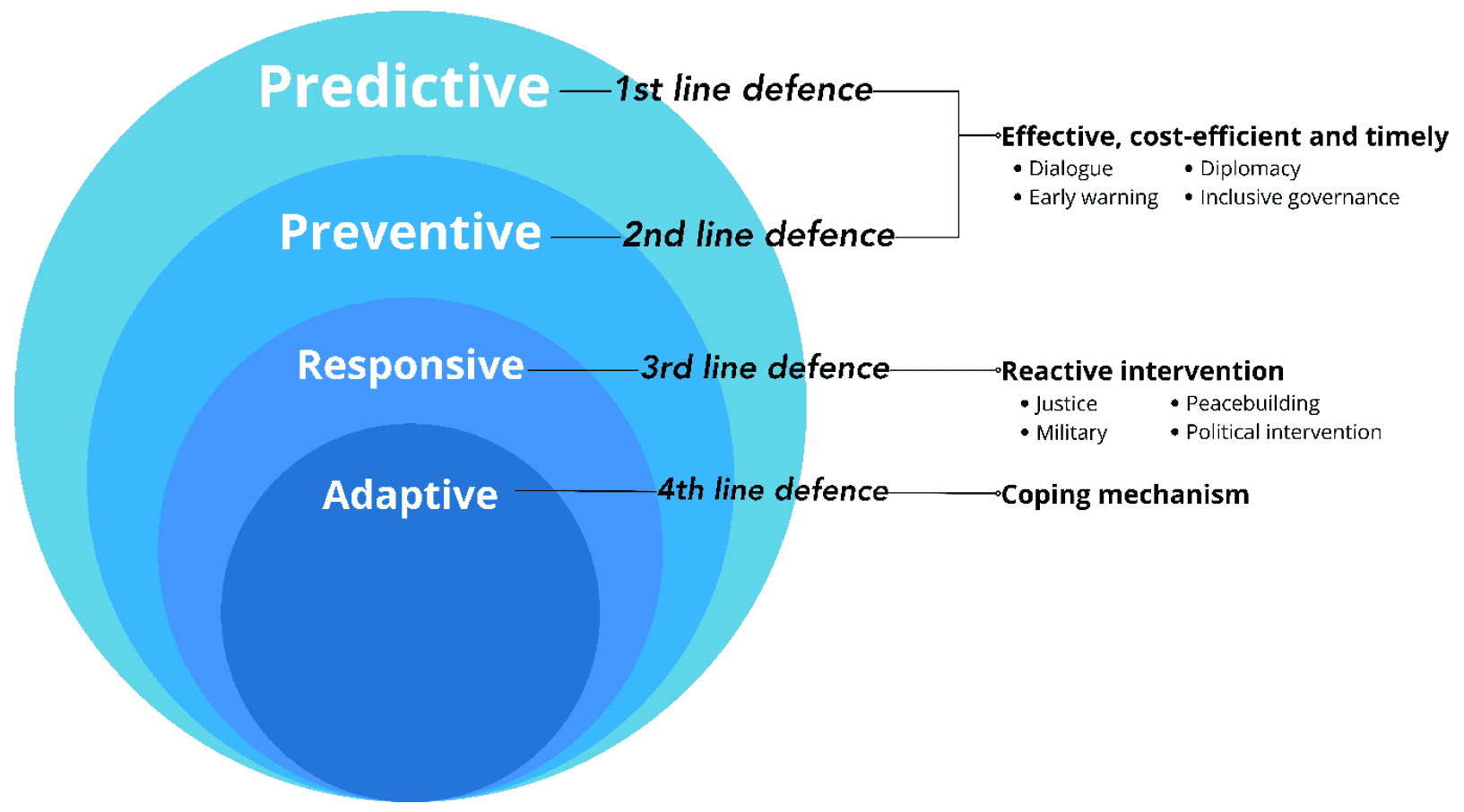
Innovating the Future will deliver four major outputs:
1. Establishing deliberative platforms
2. Publishing policy studies featuring bold and actionable proposals
3. Providing targeted technical support
4. Conducting impact missions.
Expected Outcomes
The initiative aims to achieve four transformative outcomes:
First, it will create urgency around establishing a sustainable world order, moving critical issues such as prevention mandates, the nature of the state, and local communities from the periphery to the center of policy discussions.
Second, bold proposals will be actively discussed by and between key communities, challenging conventional thinking and generating innovative solutions.
Third, African agency in global affairs will be strengthened, positioning the continent as a proactive shaper of international norms and institutions rather than a passive recipient.
Finally, peace and security architectures will be transformed to address contemporary challenges more effectively, moving beyond outdated approaches to conflict prevention and resolution. Together, these outcomes represent a fundamental shift in Africa's policy landscape and global positioning.
Strategic Approaches
The initiative employs multiple strategic approaches to achieve its objectives including:
1. Thought leadership to anticipate challenges before they escalate into crises, promoting proactive rather than reactive governance.
2. Bold proposals for institutional reform to challenge existing paradigms and advocate for structures better suited to Africa's contemporary realities.
3. Technical capacity building support for key stakeholders to strengthen the fundamental governance capabilities needed to implement ambitious policy agendas effectively.
4. Community empowerment and decentralization through states with multiple systems and strategies to ensure that transformation efforts are inclusive and responsive to local needs.
5. Constituency building to create broad-based public support through robust communications and active engagement of key drivers of the Pan-African agenda, bringing about policy innovations and implementation that are more sustainable and resilient to political changes.
6. Youth engagement and mentorship, particularly targeting Gen-Z and Millennials to harness the energy and innovation of Africa's largest demographic group.
Methodology and Theory of Change
Theoretical Frameworks for African Multilateral Coordination
The methodology used in this initiative consists in examining historical examples and different theoretical frameworks to explore how multilateral coordination functions during periods of stress.
The Three-Pillar Deliberation and Action Framework
Innovating the Future addresses a fundamental challenge in international cooperation: the siloed nature of key stakeholder communities. The initiative identifies three distinct pillars that must be bridged to achieve meaningful progress on PAAI’s priority thematic areas namely: governance, peace and security, geopolitics and multilateralism and human development.
The Political and Policy Community
This first pillar encompasses national decision-makers, policy architects, and political leadership across African nations. These actors drive domestic agendas, control resource allocation, and establish national priorities that ultimately determine a country's engagement with multilateral initiatives. Their perspectives are fundamentally shaped by domestic political considerations, electoral cycles, and perceived national interests, often creating tension between short-term political imperatives and long-term collaborative goals. The political legitimacy and capability of state institutions significantly influence how effectively this community can implement multilateral commitments domestically.
The Diplomatic and Multilateral Community
The second pillar consists of diplomats, international civil servants, and representatives to regional and international organizations. This community facilitates formal cross-border cooperation, negotiates institutional responses, and maintains the infrastructure of multilateral engagement. Their work is governed by established protocols, organizational mandates, and institutional cultures that can either enable or constrain innovation. The effectiveness of this community is often determined by the degree of authority delegated from national governments, the resources available for implementation, and the credibility of the multilateral institutions themselves.
Civil Society, Scientific, Technical, and Business Communities
The third pillar brings together non-governmental stakeholders with specialized knowledge, grassroots connections, and implementation capabilities. This diverse group includes academic experts, technical specialists, civil society organizations, community representatives, and private sector entities. These actors often possess critical data, practical expertise, and direct connections to affected populations that the other two pillars lack. Their inclusion ensures that policy solutions are technically sound, culturally appropriate, and implementable on the ground.
Deliberative Platforms
The Deliberative Platform aims to provide a safe space for a continuous regional and continent-wide approach, as well as assertive engagement and action between and by the three communities. Its design has been calibrated to ensure added value, owing to its unique methodology of deliberation and the selection of participants and speakers drawn from the field in Africa and beyond. The Deliberative Platform will emphasise on regional preventive diplomacy, continental mediation efforts, and international multilateral cooperation to address Africa's national and local problems.
The Deliberative Platform is an autonomous entity providing a regional platform to discuss, without any "taboos”, all issues affecting Africa mainly governance, peace and security and human development particularly focusing on geopolitics, identity, resource, power, accountability, transparency, borders, and similar topics.
In doing so, Deliberative Platform initiatives will focus on:
1. Providing a regional approach to addressing the complex governance, peace, security, and development challenges confronting Africa. This demands a transformation of global, regional, and national governments to effectively mediate conflicts, foster peace and security, and build constituencies for the transformation of African relations with or presence into multilateral bodies.
2. Acting on pan-African issues and bridging visions for new multilateral approaches to region-wide peace and security and preventive diplomacy, as well as for effective multilateralism. This will include collaborative mediation efforts by subnational bodies, scholars, civil society, diplomats, and political leaders and their meaningful representation in transitional, traditional, multilateral, and financial institutions.
3. Ensuring an active scholarly role in promoting preventive diplomacy and regional peace and transforming transnational governance via a multi-stakeholder partnership in the Horn of Africa.
4. Establishing a scholarly support base for regional preventive diplomacy and democratic transitions, as well as for an active and substantive agenda for the transformation of institutions of international governance.
5. Suggesting concrete interventions to make the AU, UN, RECs, US, and EU mediation and other peace initiatives more effective.
6. Ensuring ongoing media engagement throughout the process.
.png)
In an era where multilateralism faces significant challenges and intergovernmental institutions struggle with effectiveness, Innovating the Future aims to develop bold proposals for transforming global and African peace and security architectures through the Pact for the Future. The Deliberative Platform provides a framework where the three key communities play vital roles in promoting sustainable peace and security solutions.
Theoretical Frameworks for Analysis
Innovating the Future employs multiple theoretical lenses to analyze the complex interactions within and between these three pillars. These frameworks provide structured approaches to understanding how policies are formed, decisions are made, and change occurs in multilateral contexts. The initiative applies these frameworks to analyze how African multilateral institutions can be strengthened to overcome collective action problems and facilitate sustained cooperation despite divergent national interests.
Realism
Realism theory provides a critical lens for examining power dynamics in multilateral arrangements. This perspective posits that institutions and states operate primarily from self-interest, with powerful actors leveraging multilateral forums to advance their own agendas[1]. The framework helps explain why certain multilateral development institutions appear to prioritize policies and development agendas that favour goals aligned with more powerful nations. Through this lens, the initiative analyzes how power asymmetries influence agenda-setting and resource allocation in African multilateral contexts, particularly examining how dominant regional or global powers shape institutional priorities.
Liberal Institutionalism
In contrast to realism, liberal institutionalism (also called institutional liberalism or neoliberalism) argues that international cooperation between states is both feasible and sustainable, and that such cooperation can effectively reduce conflict and competition[4]. This theoretical approach emphasizes how multilateral institutions facilitate cooperation.
Constructivism
Constructivism focuses on how ideas, norms, and identities shape international politics. This approach argues that social reality is constructed through shared meanings and understandings rather than existing as objective, unchangeable facts[3]. The initiative employs constructivist analysis to examine how evolving norms regarding human rights, sustainability, and pan-African identity influence multilateral coordination. This framework is particularly valuable for understanding how new ideas can transform the perceived interests of states and reshape multilateral agendas over time.
Policy Formation and Change Frameworks
To influence, inform, and shape policy agendas we will use the following theoretical frameworks:
Global Governance Theory
Global Governance Theory examines how state and non-state actors interact to produce and enforce rules and norms across borders. The initiative applies this framework to analyze the complex web of formal institutions, informal networks, and hybrid arrangements that collectively shape policy outcomes in Africa. This perspective helps identify governance gaps where existing mechanisms fail to address transnational challenges effectively and suggests pathways for institutional innovation that blend formal authority with networked governance approaches.
Multiple Streams Framework
Developed by John Kingdon, the Multiple Streams Framework identifies three "streams" in the policy process:
. The problem stream: how social conditions become defined as problems requiring policy attention
. The policy stream: the generation and refinement of policy proposals and solutions
. The political stream: factors including national mood, interest group campaigns, and changes in elected officials
The framework suggests that policy change is most likely when these three streams converge during "policy windows" - opportunities when problems, solutions, and political will align. The initiative applies this framework to identify strategic moments when conditions are favorable for multilateral policy innovation and to develop strategies for coupling these streams to advance reform agendas.
Punctuated Equilibrium Theory
Punctuated Equilibrium Theory describes a pattern of policy development characterized by long periods of stability punctuated by brief but intense episodes of dramatic change. This approach explains how policymakers, unable to attend to all issues simultaneously, prioritize some concerns while paying minimal attention to others. The resulting pattern of attention leads to mostly incremental policy adjustments interspersed with major policy shifts when attention suddenly focuses on previously neglected issues.
The initiative applies this theory to analyze how external shocks—such as the COVID-19 pandemic, conflicts in Gaza, Ukraine, Sudan, Ethiopia, and the DRC—create potential moments of punctuation that could force major policy shifts in African multilateral arrangements. By identifying the conditions that determine whether such shocks lead to transformative change or reversion to prior equilibria, the initiative helps stakeholders prepare for and leverage moments of potential policy transformation.
Historical Institutionalism
Historical institutionalism emphasizes how timing, sequences, and path dependence affect institutional development and change. This approach highlights that once institutions are established, they tend to follow trajectories that are difficult to reverse, with earlier decisions constraining later options. The initiative applies this framework to understand how the design choices and foundational moments of African multilateral institutions continue to shape their contemporary functioning and to identify potential pathways for incremental reform that respect institutional histories while enabling adaptation to new challenges.
Advocacy and Engagement Strategies
The initiative's theoretical analysis informs a comprehensive set of advocacy and engagement approaches aimed at influencing, shaping and changing policy directions, while being tailored to different stakeholder communities. The approaches are the following
Policy Window Approach
Building on Kingdon's Multiple Streams Framework, the initiative identifies and leverages "policy windows" when problem definition, policy solutions, and politics converge to create opportunities for change. This approach involves closely monitoring political developments, preparing policy solutions in advance, and rapidly mobilizing when windows of opportunity emerge. By maintaining readiness to connect emerging problems with viable solutions in politically favorable moments, the initiative maximizes its influence on policy agendas.
Coalition Building Strategy
The coalition approach focuses on coordinating activity among stakeholders with similar core beliefs and complementary capabilities. The initiative facilitates formal and informal networks that bring together actors from all three pillars around shared objectives. These coalitions help overcome the limitations of siloed expertise by integrating political insight, diplomatic process knowledge, and technical expertise in joint advocacy efforts.
Power Politics Analysis
Recognizing the importance of elite decision-makers, the initiative maps influential power brokers across all three pillars and develops targeted engagement strategies for key individuals and institutions. This approach involves identifying decision points, understanding the incentives and constraints facing powerful actors, and crafting persuasive communications that align multilateral solutions with their perceived interests.
Media and Messaging Framework
Innovating the Future employs sophisticated framing strategies that connect policy proposals to culturally resonant values and narratives. Issues are presented in a style to help decision-making. Advocacy efforts will carefully frame solutions in a manner that appeal to diverse audiences across all three pillars, translating technical concepts into language that effectively present to political, diplomatic, and civil society stakeholders.
By integrating these diverse theoretical frameworks, Innovating the Future develops a nuanced understanding of the complex dynamics that shape multilateral coordination in Africa. This multifaceted approach enables the initiative to bridge communication gaps between the three key pillars, identify strategic opportunities for intervention, and design effective advocacy strategies tailored to different contexts and stakeholders. Through this comprehensive methodology, the initiative aims to transform how multilateral institutions address complex challenges, creating more coherent, effective, and sustainable responses to the continent's most pressing issues.
Innovating the Future will initiate a joint forum where none of the three communities dominates the conversation, and panels are always composed of representatives of all three communities. By providing such strategic deliberation platforms that redirect formal UN, AU, REC, and state and sub-national discussions, the informal conversations will serve as no-taboo forums where every agenda can be discussed freely and informally, without the constraints of politics and protocols, and where participants are invited less as officials and more as thought leaders and functionaries. Such platforms for strategic deliberation will focus on bold policy recommendations that aim to overhaul global, continental, regional, national, and local governance systems.