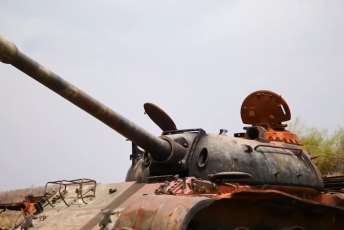
The Pretoria peace deal has succeeded in silencing the guns but fallen far short on justice, reconstruction, and broader recovery in Tigray, a new assessment concludes, warning that most substantive provisions of the agreement remain unmet year after the signing.
More than three years after the federal government and the Tigray People’s Liberation Front (TPLF) signed the Pretoria Cessation of Hostilities Agreement, implementation progress appears heavily skewed toward ending active combat while core political, justice and recovery commitments remain largely unfulfilled, according to a report published by the Pan Pan African Agenda Institute (PAAI) this week.
The report acknowledges that the agreement succeeded in halting large scale hostilities, an outcome it characterizes as achieving “negative peace.” However, it stresses that the deal has not translated into deeper structural changes required for durable stability including accountability for wartime abuses, institutional restoration, and comprehensive reconstruction.
Among the most serious shortcomings identified is the failure to operationalize transitional justice and accountability mechanisms. The assessment describes this gap as “perhaps the most consequential abandonment” of the agreement’s commitments.
Despite the Ministry of Justice endorsement of the transitional justice recommendations more than two years ago, the report finds that implementation to be virtually nonexistent.
Survey data cited in the assessment shows that nearly 89 percent of respondents do not trust either the federal government or the TPLF to deliver genuine justice and accountability.
According to the assessment, public awareness of justice efforts also remains strikingly low and more than three-quarters of respondents reported being unaware of any transitional justice initiatives.
Among those who were reportedly aware, most viewed the efforts as politically motivated or superficial, with many believing they were designed to shield perpetrators rather than center victims.
The report further notes a widespread perception that political considerations are actively obstructing accountability processes and respondents overwhelmingly expressed skepticism that there is real political will to pursue justice for atrocities committed during the conflict.
These concerns arise against a backdrop of previously documented large-scale violations during the war. The violations revealed by several international and local rights organizations include mass killings, sexual violence, forced displacement, and deliberate starvation.
The assessment notes that despite findings by international investigative bodies, no credible accountability mechanisms have materialized under the Pretoria framework. It warns that failure to address justice risks undermining the long term sustainability of the peace process and argues that without victim centered accountability and reconciliation, the agreement remains vulnerable to future instability.
The report also paints a very bleak picture of post war recovery in Tigray. It describes reconstruction and economic rehabilitation efforts as “minimal to absent” despite damage estimates reaching tens of billions of dollars.
More than 70 percent of informed respondents characterized recovery initiatives as either entirely absent or severely ineffective. According to the report, the region remains largely stuck in an emergency humanitarian phase focused on immediate survival rather than transitioning to systematic rebuilding.
It notes that “ongoing recovery and reconstruction initiatives that are often politicized (as in the case of the Endowment Fund for the Rehabilitation of Tigray, or EFFORT) and insufficient in scale result in Tigray remaining trapped in an emergency relief phase (largely conducted by REST and other NGOs) rather than transitioning toward genuine recovery or sustainable reconstruction.”
Respondents further noted a troubling decline in international donor support and engagement, an almost complete absence of large-scale reconstruction programmes, and disturbing instances of aid mismanagement and diversion by various actors.
Within Tigray itself, only minor cement production for construction and basic road maintenance work has tentatively resumed, and these modest activities are concentrated almost exclusively in the regional capital, Mekelle, leaving rural areas unaddressed, according to the report.
Participants also attributed this comprehensive reconstruction paralysis to a complex combination of interrelated factors, including federal government conditionalities that politicize reconstruction assistance; donor fatigue, as international attention shifts to other global crises; the disbanding or severe reduction of USAID programmes that previously supported development; and corruption scandals, involving both humanitarian and development agencies, that have eroded trust and accountability.
The report further contextualizes these reconstruction delays within broader structural implementation gaps. These include incomplete restoration of constitutional order and unresolved territorial control issues, both of which continue to complicate recovery planning and execution.
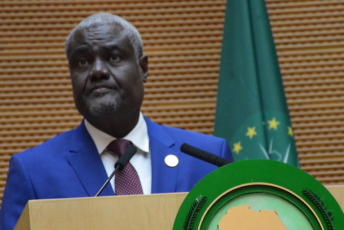
The African Union-led Monitoring, Verification and Compliance Mechanism (MVCM) established to oversee implementation also comes under criticism in the assessment. Half of survey respondents reported being unaware of any official reports issued by the mechanism three years after the agreement was signed. Participants widely describe the monitoring body as weak and ineffective with the report noting that it has produced “virtually no consequences” for systematic non-compliance.
It argued that the absence of credible oversight and enforcement has significantly contributed to stalled implementation of justice and reconstruction provisions.
In its recommendations, the report calls for urgent efforts to reinvigorate the Pretoria Agreement framework. Proposed measures include stronger international oversight, clearer implementation timelines, and enforcement mechanisms capable of imposing consequences on spoilers .
The assessment emphasizes that justice and accountability must be treated as foundational pillars of sustainable peace rather than secondary political issues. Continued impunity and stalled reconstruction, it warns, risk rendering the agreement increasingly fragile amid evolving regional tensions.
First published in The Reporter Magazine